
Extended Producer Responsibility in the construction industry

What does the construction EPR entail?
EPR requires any entity marketing construction products or materials in France to take responsibility for reducing and appropriately disposing of their end-of-life waste.
To know

Producers and retailers join a government-approved Producer Responsibility Organisation (PRO), which takes on this responsibility, in exchange for fees (eco-contributions) based on the amount of products marketed. The PRO thus handles their waste management.
How it works
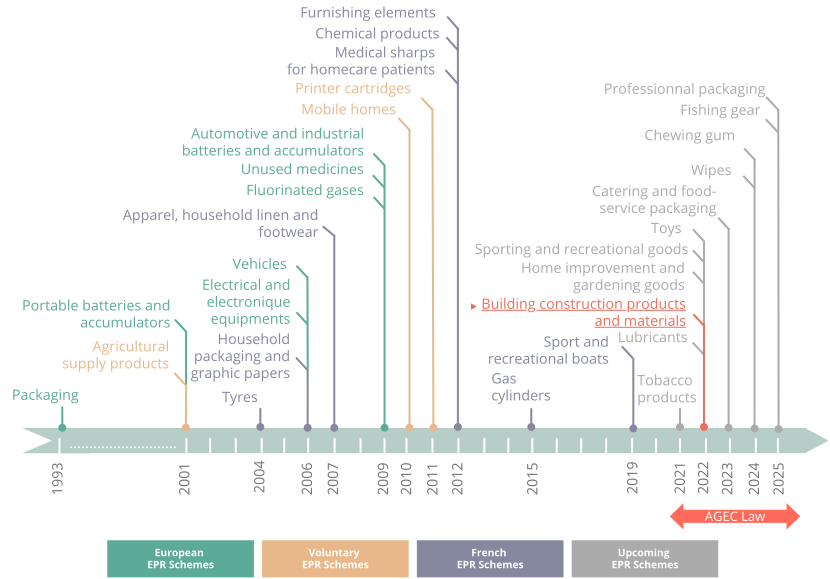
The principle of Extended Producer Responsibility (EPR) is covered under Article L541-10 of the French Environmental Code, which states that, ‘Pursuant to the principle of extended producer responsibility, any natural or legal person who designs, manufactures, handles, processes, sells or imports products that generate waste or components and materials used in their manufacturing process, […], may be required to ensure or contribute to the prevention and management of the waste resulting therefrom (…). Producers may fulfil this obligation by establishing and managing accredited producer responsibility organisations, to handle this obligation and which they pay in return.’ In France, the EPR scheme covers around twenty sectors, including household packaging, electrical and electronic equipment. Since the 10 February 2020 law regarding waste reduction and curcularity, known as the AGEC Law (Anti-Waste and Circular Economy), construction products and materials are now subject to this measure. To obey this law, these businesses must join a government-approved Producer Responsibility Organisation, which they pay to take care of their waste management. |

France is the leader in the field of producer responsibility
There are currently more than 30 EPR schemes in France, and new ones will be introduced over the next five years. The scheme for Building Construction Products and Materials (PMCB), provided for under the AGEC Law, was instated on 1 January 2022.
The AGEC Law led to the PMCB EPR. According to this law, the construction industry has been subject to EPR since 1 January 2022. Construction waste, when sorted, is collected free of charge, so that it can be traced.
The implementing order, which defines and explains the law, can be found in the French Environmental Code:
The products and materials covered by the EPR scheme include wall coverings, floors and ceilings, which are to be permanently incorporated, installed or assembled in a building or used for fittings related to its use situated on its site area, including those relating to vehicle parking, but does not include products and materials used solely for the duration of the construction project. Products and materials intended for civil engineering or public works are excluded from the ERP scheme but the persons putting them on the market are including (see Are you relevant Person putting on the market?)
The order also details the sorting of PMCB waste and the creation of collection points.
It addresses financing and gradual implementation.
It also requires distributors with sales areas over 4,000 m² (including adjacent storage areas or related storage areas in the immediate vicinity) provide space for a collection point.

The operational launch of the construction EPR Scheme: What was at Stake
Regarding the construction EPR, in concrete terms, the following are concerned: “Construction products or materials for the building sector intended for households or professionals, as of January 1, 2022, so that the construction or demolition waste resulting from them is taken back free of charge when it is subject to separate collection and so that traceability of this waste is ensured. A decree from the Council of State defines the application procedures […] as well as the minimum conditions for the network of take-back points” according to Article L.541-10-1 of the Environmental Code (AGEC Law).
The two main criteria that led to the implementation of this new EPR scheme in the AGEC law were:
- Reducing illegal dumping via free waste take-back and improving the network of collection points and traceability
- Creating less waste through recycling and reuse
Every year, the building industry produces nearly 46 million tons of waste. Though the waste recovery rate is nearly 70%, there is a huge discrepancy in rates among different work flows and types of material. Much remains to be done and the environmental and economic stakes are high.

Good to know: construction products and materials intended for the public works sector (roads, bridges, etc.) are excluded from the EPR requirement.

Requirements for market operators: working together towards a more sustainable industry
Requirements for manufacturers:
To fulfil this requirement, they must collectively establish and manage accredited producer responsibility organisations to handle waste management in return for payment.’
Requirements for distributors
Set up collection points
and facilitate the take-back of end-of-life materials.
In the EPR scheme, public waste disposal centres will also be stakeholders, though not considered distributors.

How do eco-contributions finance the EPR?
The PRO uses the eco-contribution to do the following:
- aid its members who place products on the market with their administrative procedures
- organise collection, sorting, and waste recovery (downstream)
- strengthen the upstream with environmentally-friendly designs
- inform and raise awareness
Those who place products on the market fulfil this requirement collectively establish and manage accredited producer responsibility organisations to handle waste management in return for payment: this payment is an eco-contribution.
Indeed, in order to properly function, the EPR needs funding. This is where the eco-contribution comes in: producers then integrate the eco-contribution to their retail prices, thus compensating for the collection and treatment costs. It is calculated according to the collective effort needed to reach the set goals.

What is PRO Valobat’s role in the PMCB EPR?
Valobat, created by 26 leading partners in the construction industry, has applied for approval to become the multi-material PRO for all waste streams (inert and non-inert).
Our goal? To provide a solution for every piece of construction waste and for everyone working in the industry.
A PRO works closely with all parties involved to:
- Expand reuse,
- Increase recycling rates,
- Increase recovery rates,
- Make using recycled content easier,
- Support the development of environmentally friendly design.
Goals which are consistent with new environmental regulations (RE 2020) and meet the expectations of those placing products on the market.
Valobat intends to reach these objectives by:
- Increasing network density,
- Implementing the free take-back of separately collected waste streams,
- Helping reduce illegal dumping,
- Communicating and raising awareness in the industry,
- Investing in Research & Development.
Developing solutions to optimise operations and reduce costs for those placing products on the market.
The Order of 10 June 2022 allowed Valobat to submit its application for government approval and set out the specifications on how PROs must implement procedures for this industry as well as the goals it must reach.
It details PRO requirements pertaining to:
- Establishing eco-modulations (from 2024);
- Expanding the network of collection points (every 10 or 20 km);
- Conducting studies (reuse, recyclability inhibitors, etc.);
- Increasing free take-back for sorted waste;
- Traceability;
- Expanding reuse and repurposing;
- Finding awareness and communicatios campaigns.
Valobat’s approval decree: Valobat submitted an application for approval to the government in July 2022. It details Valobat’s governance, its technical and economic ability to become a producer responsibility organisation, its project for the construction industry, and how it intends to achieving the objectives set out the aforementioned specifications. Based on this application for approval, Valobat is now approved and offers its membership contract to those placing PMCB on the market.
Stay connected so you don’t miss any news from the construction industry or updates on our services!
Sign up for the newsletter

